;fill-rule:nonzero;stroke:%23000;stroke-width:48.7px;'/%3e%3cdefs%3e%3clinearGradient%20id='_Linear1'%20x1='0'%20y1='0'%20x2='1'%20y2='0'%20gradientUnits='userSpaceOnUse'%20gradientTransform='matrix(2406.25,-2101.13,2101.13,2406.25,1086.43,2157.14)'%3e%3cstop%20offset='0'%20style='stop-color:%232d1f30;stop-opacity:1'/%3e%3cstop%20offset='1'%20style='stop-color:%239f5060;stop-opacity:1'/%3e%3c/linearGradient%3e%3c/defs%3e%3c/svg%3e)

Smartifying a washing machine
This article extends the basics covered in
 Smartifying your devices to a device with a more
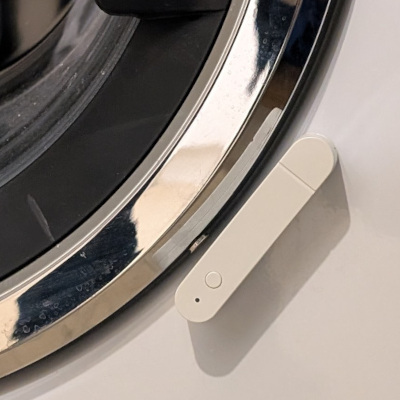
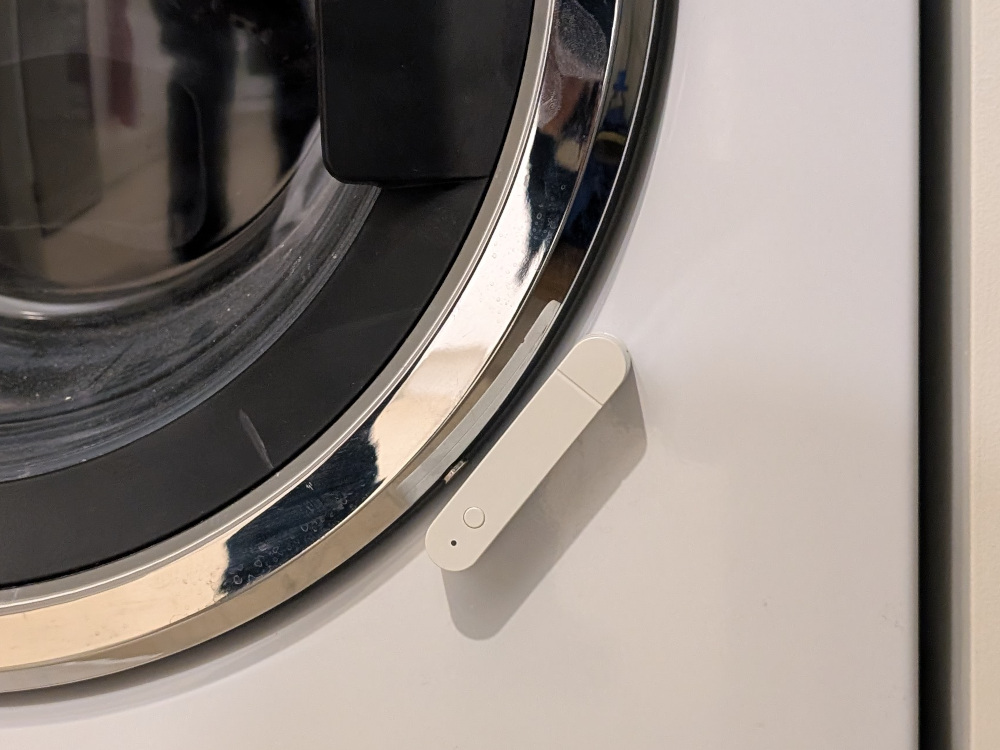
complicated state: A washing machine. By using both a smart power plug and a contact sensor, we
can track the activity of the machine, and the state of the door. For example, this helps us
identify when a washing machine cycle has finished, but the load has not yet been emptied.
Smartifying your devices to a device with a more
complicated state: A washing machine. By using both a smart power plug and a contact sensor, we
can track the activity of the machine, and the state of the door. For example, this helps us
identify when a washing machine cycle has finished, but the load has not yet been emptied.
We'll build up the washing machine's state machine incrementally, based on specific triggers that we get from the smart devices.
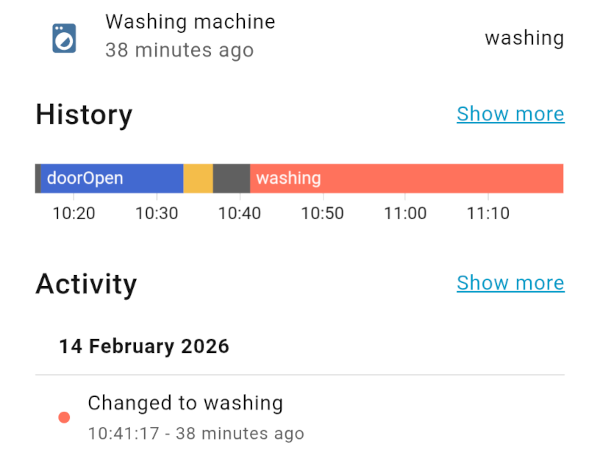
In this article, we'll skip the imperative approach and go straight to the state machine examples. Continue scrolling to see the Node-RED implementation.
Keep reading if...
- You have access to advanced Smart Home tooling, like Home Assistant.
- You're familiar with state machines, and modelling device state in Node-RED
- You keep forgetting to take the washing out when it's finished
Sensors and triggers
We will use a contact sensor and a smart power plug. Instead of imperatively mapping the smart home sensor events directly to actions, we will treat them as "triggers" to influence the device state.
In addition, we'll also take advantage of the device state itself to provide additional information - state duration helps us identify if a cycle has finished, and trigger reminders if a cycle has finished, but if the door has not been opened for a while since then.
We'll start with the contact sensor.
Contact sensor: Is the door open?
The door sensor let us estimate when a load is added or removed. We won't know if the washing machine is empty or full, but we can cross-reference this with other sensors soon.
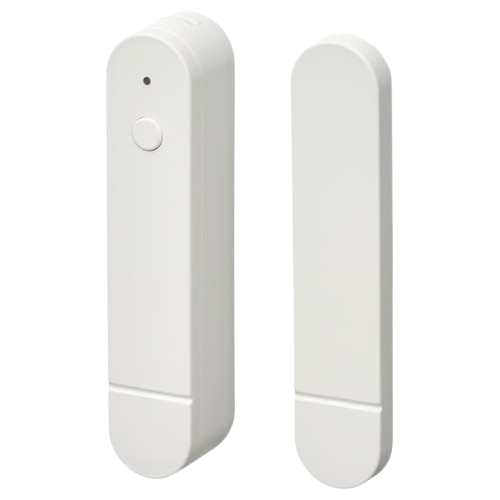
isOpen and
isClosed triggers.Smart power plug: Is it washing?
While it may be possible to identify specific cycle information by monitoring the power usage, we only need to identify when the washing machine is running a cycle, or when it isn't.
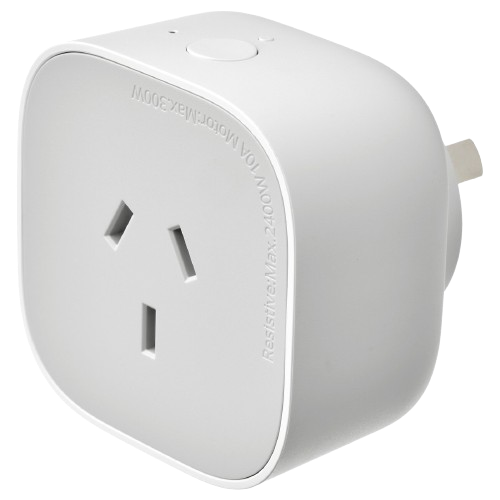
powerHigh,
powerLow and powerOff triggers.
While it's possible to model the "Power off & door open" and "Power off & door closed" as separate states, the added complexity does not benefit us because the transitions are the same. Ideally we would model them as a substates in a hierarchical finite state machine, so the information is still available in the model without additional overhead.
Timing transitions: Did the cycle finish?
We're still missing something critical from these triggers; the ability to identify when the
washing machine has finished a cycle. Cross-referencing the
powerLow trigger with the washing state
duration, we can decide which next transition is most appropriate:
-
If
powerLowtriggers soon after starting a cycle (e.g. pausing it to add more clothes), consider the cycle cancelled. Otherwise we don't care. -
If
powerLowtriggers after the cycle has been running for 30 mins or more, consider the cycle finished.
This expands our model further, to represent "finished" as new state, distinct from "ready".
"Finished" represents a washing machine that has finished a cycle, and is full of clean clothes. We assume the clothes are removed when the door is opened.
Modelling the state machine
Since this state machine is just a rough model of a physical process using simple sensors, there are cases where transitions may be missed. We can add safe defaults for some triggers, allowing transitions without regard for the "from" state.
| Trigger | From | To | Comment |
|---|---|---|---|
| doorOpened | (any) | doorOpened | Door opened while the washing machine is in any other state. |
| doorClosed | (any) | ready | Door closed while the washing machine is in any other state. |
| powerHigh | (any) | washing | The washing machine is running a cycle. Implies that it's on and the door is closed. |
| powerLowLongTime | washing | finished | The only way to transition to "finished", low power after washing for > 30 mins. |
| powerLowShortTime | washing | ready | Low power after washing for < 30 mins. |
| powerOff | washing | ready | If the power drops while washing, assume it's been cancelled. |
Putting it all into Node-RED
As with Smartifying your devices, we're representing the
device state using the
node-red-contrib-home-assistant-websocket
and
node-red-contrib-persistent-fsm, nodes.
Reminders
Further taking advantage of the state duration, we can add additional state nodes that fire when
the washing machine has been in the finished state for a certain
duration. The "announcement" node delegates to a TTS to verbalise messages and play them as
announcements.
Which reminds me to stop what I'm doing and put the washing out:
- 🤖 Smart Home agent
- ...🙄
Wrapping up
Smartifying a washing machine with multiple sensors led to a more complicated state machine than
the example in Smartifying your devices, but it's good to
prove that the process can scale. I'll be keeping an eye out for other
Smart Home sensors and actuators at IKEA
that can further smartify my devices.
If you have feedback or questions about this article, let's catch up via email.

 All articles
 About Sinclair Studios